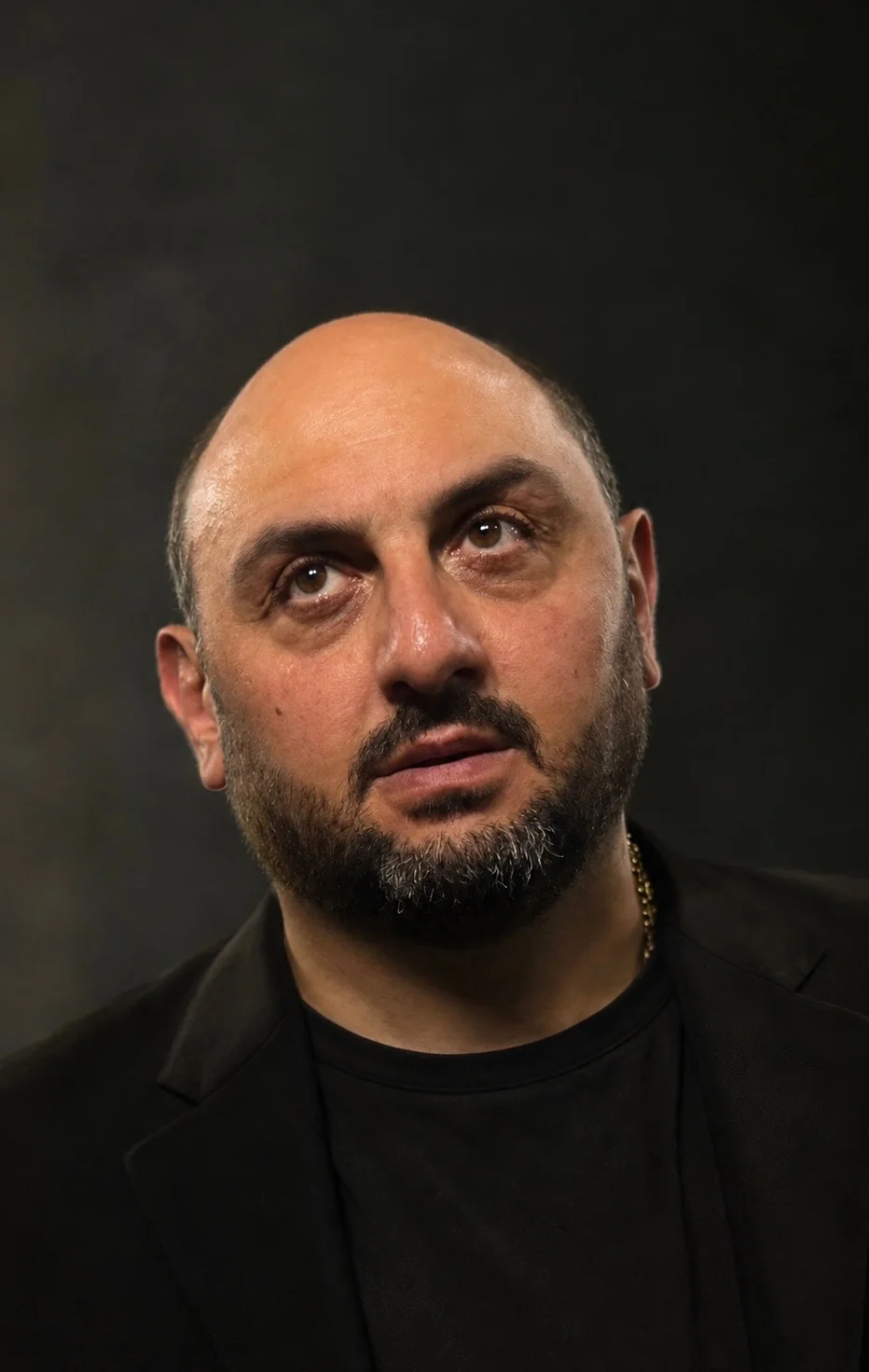
KHACHATUR BALBABYAN
“He is unique.”
Khachatur Balbabyan’s artistic journey began not with ambition, but with recognition. At the age of five, his parents saw something extraordinary in the way he shaped clay and drew on paper. They invited a professional artist to observe him. After watching quietly, the artist turned to his parents and said: “He is unique.” That moment marked the beginning of a life devoted to creation — one built on four foundational pillars: Uniqueness, Beauty, Meaning, and Precision.
Four foundational pillars
- Uniqueness
- Beauty
- Meaning
- Precision
That moment marked the beginning of a life devoted to creation.
A life in chapters
1979
Early Foundations: Where Form Met Spirit
Born in 1979 and raised in Yerevan, Armenia, Khachatur entered a specialized art school at age eight, where he studied painting and drawing until age twelve (1987–1991). These years coincided with the collapse of the Soviet Union and the birth of the independent Republic of Armenia — a time of national chaos and spiritual awakening. Within this storm of change, art became more than education; it became expression, survival, and identity.
At age ten, he held his first solo exhibition of symbolic paintings reflecting the Armenian independence movement. During that time, he recalls drawing not for school, but to translate the emotions that overwhelmed his spirit. From the beginning, Khachatur rejected every art form that lacked meaning. Symbolism became his language.
1985
The Sense of Beauty
The sense of beauty emerged early and vividly. As a child, Khachatur once stared intently at his mother’s diamond ring. When asked why he was smiling at it, he answered, “Because the stone is smiling at me.” Beauty, to him, was alive.
Later in life, beauty became a more conscious standard. Through years of visiting museums, studying art history, and restoring antique artworks in his own gallery, Khachatur refined his eye. He touched and examined over fifty 19th-century European paintings during the years he ran his gallery — an experience that helped him see beauty as a conversation between time, form, and emotion.
1990
Jewelry and Precision
In 1990, at the age of eleven, his parents arranged for him to apprentice under a local silversmith. For a year, three days a week, he immersed himself in the world of metal and fire, learning the delicate craft of jewelry. He created several fine brooches and silver rings for his mother — learning not only technique, but the virtue of precision. Years later, this pillar deepened when he studied the meticulous work of Carl Fabergé, whose craftsmanship showed that precision could itself be poetic.
Even earlier, at age seven, Khachatur sculpted a miniature army of clay soldiers, each barely an inch tall — complete with detailed buttons and uniforms. This extraordinary feat of patience and detail left an unforgettable impression on his family and visitors. Precision was not a learned skill; it was an instinct awakened.
1995
Academic and Artistic Maturity
After a brief hiatus from painting during his teenage years, Khachatur entered the University of Architecture and Construction of Yerevan in 1995. There, under the mentorship of some of Armenia’s most respected architects, he cultivated a deep understanding of space, structure, and the built environment — developing the ability to turn imagination into physical form. He graduated with pride, carrying both technical knowledge and artistic maturity.
2000
Arrival in the United States — and the Silent Years
In 2000, Khachatur moved to the United States — a turning point filled with uncertainty. For the first seven years, he worked tirelessly to survive and integrate. During these years of silence in painting, he found a different outlet: poetry. He wrote over a hundred poems in Armenian, using the pen as his brush to shape invisible feelings into words.
In 2007, he returned to visual art. Visiting a local art store, he bought brushes and canvases and began to paint his imagination. This led to a new body of symbolic paintings that he exhibited at several art fairs. He never priced them. Instead, he sought something else — reaction. And when he saw strangers stop, pause, and connect with his work, he knew: his art could speak without explanation.
2013
Craftsmanship and the Language of Materials
Between 2013 and 2020, Khachatur immersed himself in craftsmanship and construction, working in luxury homes and specializing in finish carpentry and cabinetry. This experience not only sharpened his skills but gave him a deep reverence for materials—wood, stone, and metal became extensions of his own sensibility. At the same time, he completed studies at the Sotheby’s Institute of Art and NYU, where he became a certified art appraiser.
2020
The Birth of Sculpture — and the Voice of Resistance
In 2020, the world faced a pandemic — and Armenia, once again, faced war. Feeling voiceless in the face of injustice, Khachatur turned back to art, this time through sculpture. He began to collect natural objects—driftwood, stones, metals—and merge them into bold, symbolic works.
He didn’t choose these materials. They chose him.
Each piece of driftwood, he says, has a soul and a story. Some may have come from European backyards, centuries ago, washed through oceans, and found their way to the shores of New Jersey, where he discovered them. In these relics of nature, he found not just beauty, but resilience. They were survivors, like him.
His sculptures, often joined with metal elements, are harmonies of tension—between man-made and natural, chaos and order, light and shadow. They are thresholds, testimonies, and portals—each shaped with a spiritual intention and a physical discipline.
He believes that the true artist is not a decorator, but a witness. That truth, dignity, and presence must guide the hand that creates. These three virtues, like his four pillars, are not abstract beliefs — they are standards he lives and works by.
“Nature creates the first form, the artist discovers what it can become.”
Khachatur BalbabyanToday
Today, Khachatur Balbabyan continues to create not just with his hands, but with his heart, memory, and enduring faith in the transformative power of art.
This is not a career. This is not a product. This is not a style.
This is his declaration
Creation still matters. Beauty still heals.
And from brokenness, something holy can still rise.